
Why was King Dhritarashtra of Hastinapur born blind
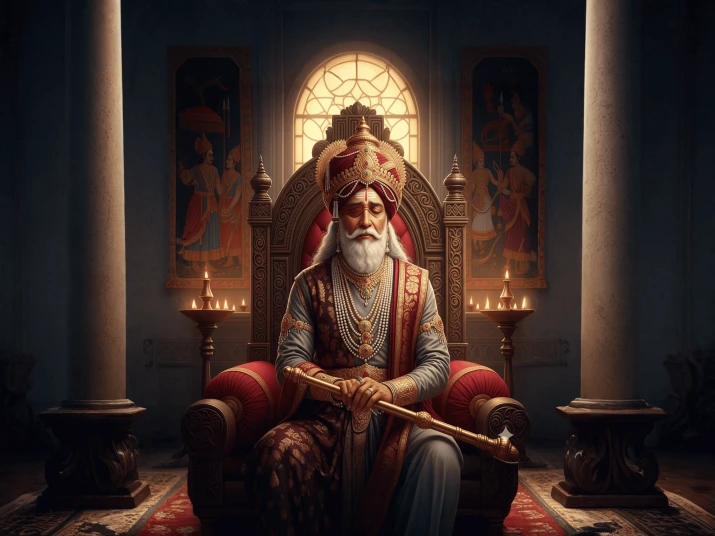
Table of Contents
- Why was King Dhritarashtra of Hastinapur born blind?
- Was Dhritarashtra a failed king?
- Was Dhritarashtra's blindness only physical, or is it also a symbol of mental and moral blindness?
- Why could he not stop the wrongdoings of his sons, even as a king? What is the main reason for his weakness?
- Why does Dhritarashtra repeatedly support Duryodhana? Is it because of paternalism or weakness for power?
- Is Dhritarashtra's blindness used symbolically as a metaphor for "lack of insight"?
- Is it pride, fear, or false belief that he did not accept the advice of Krishna and Vidura?
- Why did Dhritarashtra's leadership stand by injustice even after seeing the truth?
- What could be the social impact if today's parents indulge in the wrongdoings of their children like Dhritarashtra?
- How can a leader throw a state into crisis due to bias?
Why was King Dhritarashtra of Hastinapur born blind?
Dhrudrashtra, one of the central characters of the Mahabharata, the king of Hastinapur and the father of, was a born blind person. Dhritarashtra's blindness is not just a physical limitation, but it is much more deeply symbolic. Bears meaning. In the description of Mahabharata, Dhutrashtra is shown as a ruler who is not only physically Not only was he blind, but he was also morally and mentally blind. This moral blindness of his was the main reason for the war in the Mahabharata.
We know that according to the description of the Mahabharata, Dhritarashtra was born blind. Dhrudrashtra was the king of the Kuṇḍarb clan, and he was at the time of the Kurukshetra war between the Pandavas and the Kuṇḍarbs. Was the ruler of Hastinapur.
If we examine Dhritarashtra's blindness in a symbolic sense, the situation becomes clearer. But many believe that Dhritarashtra's blindness was not only physical. He was blind in seeing and understanding many things from a moral and mental point of view. Because of his blind support and favoritism towards the wrongdoings and immorality of his children. The war of the Mahabharata started.
Blindness of Dhrudrashtra: A symbolic analysis of physical and moral blindness is presented below. Here are:
Physical Blindness
Dhritarashtra's physical blindness affected his entire life. He took charge of the governance of the state, but due to his blindness, he was unable to manage the actual governance. Always expressed weakness. What is most required of a ruler – নিয়পগ্রায়তা, moral wisdom, and consistency. The sense of judgment was absent in the state. His blindness was not limited to his physical eyes only, but also to his thoughts, conscience, and He also swallowed his sense of justice.
Moral lindness
Dhritarashtra's moral blindness is one of the most important issues of the Mahabharata. As a king, his biggest responsibility was to establish justice for his subjects. But he failed to do so. His children, especially Mishra, are constantly involved in wrongdoing and unethical decisions. They were educated, but Dhritarashtra never tried to bring them onto the right path. His own weakness and blind support for his children gradually created chaos in the kingdom. Did it.
Dhudhastra knew well that the conduct of mischief and fraudsters was justified, and Immorality is harming the state. Still, he considered himself weak and was afraid to take any strong action. On the one hand, his silence towards the Pandavas and his sense of justice, on the other hand, his partiality towards the Kauravas, is A prime example of the moral blindness of Dhrudhastra.
Bias and blind support
Dhritarashtra's biggest weakness was his blindness towards his children. Samirthan. Duryodhana, his first son, harbored violence and hatred towards the Pandavas, making him very immoral. Was the source of karma. Unfair behavior of Duryodhan, insulting, usurping the kingdom and property of the Pandavas. Wanted - not to provide any hindrance to Dhritarashtra in this activity and to continuously support it. Very important.
Dhritarashtra got the opportunity several times to move away from this trend of favoritism for the welfare of the kingdom. And to work towards establishing justice. But he failed to fulfill that responsibility, as a result of which there was conflict between the Kauravas and the Pandavas. Take final form, and the battlefield begins.
Symbolic analysis
Dhritarashtra's blindness is symbolically understood as mental and moral blindness. As a symbol. In the philosophy of the Mahabharata, Dhrudrashtra is not only a physically blind person, but he is also a ruler who was unable to differentiate between truth and lie, justice and injustice, right and wrong.
His moral blindness is a symbol of his inability to establish justice in society. The first and foremost responsibility of a ruler is to ensure justice. Due to Dhritarashtra's failure to follow that path, chaos was created in his kingdom. Dhrudrashtra's blind support, weakness, and favoritism towards his own family made him the leader of the Mahabharata. Made him the most important and tragic character.
Was Dhritarashtra a failed king?
The duty of a king is to ensure the safety, welfare, and justice of his kingdom and subjects. To do. In ancient Indian philosophy, kingship was seen as a very important and great responsibility. Establishing policy and justice for a king and conducting governance in the right and equitable way. It is essential to use it. Some important points about the king's religion are discussed below:
1. Establishment of justice
The main responsibility of Rajdharma is to establish justice. A king or ruler must treat his subjects equally and, based on justice, will have to rule. One should not show favoritism under any circumstances. Fairness and impartiality are important for proper governance.
2. Protection of citizens
The king is responsible for the safety of his subjects. He will protect his kingdom from external enemies, attacks, and internal chaos. To maintain the peace and stability of the kingdom, the king has to be strong and courageous.
3. Follow the path of policy
It is very important to follow the path of policy or religion in Rajdharma. A king should look out for the welfare of his kingdom and people rather than his own personal desires or feelings. Taking the right and ethical decisions. The king's behavior and governance should be based on morality.
4. Economic growth and social welfare
The king is responsible for the economic development and social welfare of his kingdom. Responsible. During his rule, attention will be given to the development of agriculture, trade, education, and industry. To improve the quality of life of the citizens by maintaining the wealth and economic stability of the state. King's responsibility.
5. Maintaining peace and stability
The king has an important role in maintaining peace and stability in Rajdharma. The king has to work to prevent social chaos, inequality, and riots. He will be prudent and patient in establishing peace in the society.
6. Participation in charity and public service
In Rajdharma, the king's public service and charity are also seen as a great responsibility. Helping the poor or helpless among the subjects and working for their welfare is one of the king's responsibilities.
7. Taking advice
The religion of a good king is to take advice from wise and experienced advisors. Taking advice from wise people and making decisions with sound judgment, rather than deciding everything himself, is the sign of a just king.
8. Self-control
The king or ruler should keep his own emotions and desires under control. The religion of a king is not to take any decision out of anger, greed or jealousy. He should always conduct his rule in the light of scriptures, principles, and religion.
Conclusion:
Dhritarashtra's blindness is not only a lack of physical sight, but also a symbol of his moral and mental weakness. As a king, his duty was to establish justice and make the right decisions, but he failed in that duty. His blindness was not limited to his eyes only, but also to his thoughts, conscience, and morality. This moral blindness of Dhritarashtra became one of the reasons for the Kurukshetra War of the Mahabharata.
A big lesson can be learned from Dhritarashtra's life—deviating from the path of morality and justice as a ruler or leader can bring disaster not only for himself but also for the entire society.
The religion of a king is not only to hold power or rule, but also to ensure the justice, protection, and welfare of his subjects. Following the path of principles, establishing justice, and acting with kindness and goodwill towards his subjects is the religion of a true king.
Was Dhritarashtra's blindness only physical, or is it also a symbol of mental and moral blindness?
Although Dhritarashtra's blindness in the Mahabharata is apparently physical, the author does not present him as just a sightless man. Rather, his blindness symbolizes a deeper mental and moral weakness. Being physically blind, he could not see the truth, but the bigger problem was that he did not want to accept it. This unwillingness is the root cause of his mental blindness.
During the Kaurava-Pandava conflict, Dhritarashtra repeatedly knew that Duryodhana's behavior was unjust, greedy, and would lead to destruction. Even Vidura, Bhishma, and Drona warned him. However, paternal love, weaknesses, and fear of losing power did not allow him to stand on the path of truth. This hesitation is a manifestation of his moral blindness. He knew injustice, yet did not have the courage to resist. Even as the presiding king, he failed to take any strong decision in favor of justice. This inaction of his was one of the reasons for the destruction of Kurukshetra.
Dhritarashtra's blindness, therefore, is not simply a matter of congenital physical limitations; it is a symbol of those leaders who, despite knowing the truth, condone injustice out of self-interest, affection, or fear. His character reminds us that blindness in the eyes is as dangerous as blindness in the conscience. The Mahabharata uses Dhritarashtra as a warning: the responsibility of leadership is not just to see, but to see and make the right decisions.
Thus, Dhritarashtra's blindness was a complex symbol, a powerful manifestation of mental and moral blindness as well as physical.
Why could he not stop the wrongdoings of his sons, even as a king? What is the main reason for his weakness?
There were several deep psychological and moral reasons behind Dhritarashtra's not being able to stop the wrongdoings of his sons, even as a king. Basically, the roots of his weakness are rooted in three places: paternal love, self-contradiction, and a sense of inadequacy.
1. Over-patriarchal love and bias
Duryodhana was the eldest son of Dhritarashtra and the heir to the throne. Dhritarashtra suffered from a kind of inferiority complex all his life due to his blindness. Therefore, he wanted his son to achieve the glory that he could not. This strong bias forced him to remain silent even after seeing Duryodhana's crimes. Filial love overshadowed his sense of judgment.
2. Self-contradiction and cowardice
Dhritarashtra actually knew that Duryodhana was doing wrong. But he remained silent for fear that if he stood up for the truth, he would disobey him. There was a kind of weakness in his character: he wanted to avoid conflict. Leadership requires firmness, and that firmness was absent in him. As a result, he listened to advice but did not make decisions.
3. Sense of inadequacy and dependency
Dhritarashtra felt from childhood that he was not a full-fledged king due to his blindness. He relied on the advice of Vidura, Bhishma, or Dushmanta, but could not use his own willpower. This inferiority complex made him weak and left him indecisive.
4. Fear of losing power
He knew that Duryodhana was strong and vengeful. He remained silent, fearing that opposing him could destabilize the throne or the kingdom.
Dhritarashtra could not stop the injustice of his children because he was mentally weak, overly biased, lacked confidence, and was cowardly. This weakness of his pushed not only his family, but the entire Kuru dynasty towards destruction.
Why does Dhritarashtra repeatedly support Duryodhana? Is it because of paternalism or weakness for power?
In the Mahabharata, Dhritarashtra's character reflects a complex conflict. Even though he is a king, his decisions often lean towards Duryodhana's interests. The question arises, is the main reason for this support only paternalism, or his deep weakness for power? In fact, both factors have worked equally in Dhritarashtra's behavior, and this duality has led him from the path of a responsible ruler.
First, paternalism was unusually strong in Dhritarashtra's mind. Duryodhana was his eldest son and the only legitimate heir to the throne by birth. Due to physical blindness, Dhritarashtra suffered from an inferiority complex all his life; therefore, he wanted to make up for his own shortcomings through his son's success. By fulfilling any of Duryodhana's wishes, he tried to cover up the wound of his own powerlessness. As a result, even when he knew his son's wrongdoing, paternal love prevented him from standing against the truth.
Secondly, Dhritarashtra was not without weakness for power. He knew that Duryodhana was naturally ambitious, vengeful, and capable of creating a powerful political circle. Therefore, opposing his son could destabilize the throne. This fear made him more flexible. Even as a king, he often sacrificed morality to retain power. His sense of inadequacy made him dependent on Duryodhana, and this dependence was another deep reason for his support.
Therefore, it can be said that Dhritarashtra's love for Duryodhana in the court was not just a paternal emotion. Behind it lies the fear of losing power and the long shadow of personal weakness. Under the combined influence of the two, he ignored justice and pushed the Kuru dynasty towards destruction.
Is Dhritarashtra's blindness used symbolically as a metaphor for "lack of insight"?
Yes, in the Mahabharata, Dhritarashtra's blindness is symbolically presented as a metaphor for "lack of insight" or lack of self-knowledge. His physical blindness is not just a congenital weakness. It is a reflection of his mental and moral limitations.
Dhritarashtra hears the truth and reality, but does not feel it. This is the main form of his lack of insight. Starting from Vidura, Bhishma, and the wise men of the assembly, he repeatedly warns him, trying to explain the consequences of his arrogance and injustice, but he cannot deeply understand. That his silence is actually leading to destruction. He fails to see the truth behind the situation; this is his symbolic blindness.
Apart from that, the main qualities of a just ruler should be foresight and the ability to self-criticize. Both of these are absent in Dhritarashtra's case. He cannot see with his eyes, and he does not want to understand with his mind. His judgment is clouded by filial love, attachment, and fear. As a result, he cannot clearly perceive the depth of injustice, political danger, or moral truth.
In the poetic language of the Mahabharata, therefore, Dhritarashtra's blindness does not only speak of physical limitations. It is symbolic of all those people who, despite being in power, do not want to understand the truth, do not admit their own weaknesses, and keep their moral sense blind.
Therefore, it can be said that Dhritarashtra's blindness is undoubtedly a powerful metaphor for lack of insight, which makes the moral teaching of the poem deeper and more permanent.
Is it pride, fear, or false belief that he did not accept the advice of Krishna and Vidura?
There is no single reason behind Dhritarashtra's not accepting the advice of Krishna and Vidura. Rather, pride, fear, and false belief. These three reasons together make up his indecisive and weak character.
1. Pride
Dhritarashtra considered himself a king, even though he was blind, and this pride did not allow him to understand many truths. Accepting the advice of Krishna or Vidura meant admitting his mistakes, which hurt his self-respect. He felt that following the advice of others would reveal weakness and reduce the trust in him to manage the affairs of the kingdom. This inner pride prevented him from making the right decision at the right time.
2. Fear
The role of fear was deeper. Duryodhana was politically powerful, influential, and vengeful. Dhritarashtra knew that standing against his son would create a risk of rebellion in the family, instability in the kingdom, and loss of power. He did not dare to accept Krishna's peace proposal or Vidura's fair trial. Because it might have brought Duryodhana's wrath upon him. This fear kept him inactive and silent.
3. False Beliefs and Prejudice
Dhritarashtra had a kind of blind faith in Duryodhana. He thought that Duryodhana would sustain his dynasty and that if the Pandavas' power increased, the share of the throne would decrease. This misconception did not allow him to see the truth. Vidura's or Krishna's advice never seemed completely acceptable to him. His prejudice towards Duryodhana was deeply embedded in his mind.
Dhritarashtra could not accept Krishna and Vidura's advice because he had pride, fear, and blind and wrong faith in his son. The combination of these three turned him away from the path of justice and made the great destruction of Kurukshetra inevitable.
Why did Dhritarashtra's leadership stand by injustice even after seeing the truth?
Yes, the reflection of the behavior of a leader like Dhritarashtra can be seen in today's society. But it is reasonable not to mention the name of a specific person. However, the characteristics of the type of leaders who are seen with Dhritarashtra's instinct can be identified very clearly.
1. A leader who abandons the path of justice due to party pressure
Many elected representatives know that any decision will harm the people, but if they act against the high-ranking leaders of the party, their position, ticket, or political future may be threatened. They remain silent due to this fear. Just as Dhritarashtra did not stand by the truth for fear of Duryodhana, many leaders place the interests of the party above justice.
2. Leadership that hides corruption or injustice for fear of losing power
There are leaders in various countries who know that the ministry, administration, or close associates are doing injustice, but if they reveal it, their own power will be weakened. They do not reveal the truth due to this fear. This weakness towards power is the modern reflection of Dhritarashtra's mentality.
3. Leaders who sacrifice morality for the sake of popularity
Leaders never tell the hard or unpopular truth for fear of losing public support. They know that if they take the right decision, some people will be dissatisfied, but in the name of popularity, they choose silence.
4. Favoritism towards relatives or close circles
Many times, leaders are active in protecting their family members, business associates, or people close to their party even if they know the wrongdoings. Just as Dhritarashtra was partial to Duryodhana, the same mental structure is seen in their case.
Therefore, there is a lack of such leaders in today's society. Those who do not stand for justice, even though they know the truth, for fear of losing their position, power, or interests. Dhritarashtra is therefore not just a character from the past; he is also a symbol of a deep weakness in human nature today.
What could be the social impact if today's parents indulge in the wrongdoings of their children like Dhritarashtra?
In today's society, if parents indulge in the mistakes of their children like Dhritarashtra repeatedly, the impact can be widespread and long-lasting, not only in the family. It can be widespread and long-lasting in the entire society. Just as Dhritarashtra knew the injustice of Duryodhana, he remained silent. Similarly, in modern society, covering up mistakes in the name of fear of losing love or respect for his child creates a deep crisis.
1. Children lose their moral sense
If a child makes a mistake and the parent hides it or justifies it with logic, he thinks. Even if he makes a mistake, there is no problem; no one will stop him. As a result, his moral sense and sense of responsibility decrease.
2. Criminal tendencies can increase
Unrestrained freedom and impunity for mistakes often push him towards reckless behavior, cheating, bullying, and major crimes. If the habit is formed in childhood that the family will save him. The rules and regulations of society become insignificant to him.
3. Unrest in school and society
A child who is uninhibited at home carries the same behavior outside. Bullying, fighting, lying, or disrespecting teachers at school are often the result of excessive indulgence by the guardian.
4. The value of competence and hard work is destroyed
A child who gets everything easily does not learn to work hard. He does not even develop the strength to handle failures in life. As a result, he becomes unstable, mentally weak, and prone to problems in adulthood.
5. Spread of inequality and immorality in society
Children who are pampered are not responsible citizens in the future. Rather, they may become selfish, authoritarian, or abusers of power. This weakens the sense of justice in society and creates a culture of immorality.
Blind indulgence by the guardian not only weakens the child. It has a destructive effect on the entire society. Therefore, blind support for mistakes like those of Dhritarashtra is not. Teaching discipline, responsibility, and morality with affection is true fatherhood and motherhood.
How can a leader throw a state into crisis due to bias?
The main qualities of a leader are justice, foresight, and the courage to make decisions. But if leadership becomes a prisoner of bias, the state quickly falls into crisis. Dhritarashtra of the Mahabharata is one of the strongest examples of this truth. Even as a king, he showed excessive bias towards Duryodhana. And it was this blind bias that pushed the Kuru dynasty towards destruction.
Dhritarashtra knew that Duryodhana's behavior was arrogant, unjust, and vindictive. Vidura, Bhishma, and Krishna repeatedly warned him that this path would bring harm to the state. But Dhritarashtra, blinded by filial love, did not want to face reality. His bias prevented him from seeing the truth and taking tough decisions at the right time. As a result, injustice was repeated again and again. Such as the insult of Draupadi, the game of gambling, and the exile of the Pandavas. And with each step, the crisis of the state intensified.
When a leader stands up for personal interests, the administration is weakened, and distrust in justice is created. In the case of Dhritarashtra, we see that his favoritism was not only familial; it was also politically damaging. As Duryodhana’s wrongdoing went unpunished, arrogance grew among the Kauravas and morality collapsed within the kingdom. This personal weakness of the leader ultimately made the Kurukshetra War inevitable. In which countless lives were lost, and entire dynasties were destroyed.
Therefore, the example of Dhritarashtra teaches us that a leader’s favoritism not only weakens the state. It can also put justice, stability, and the security of future generations at extreme risk. The price of a leader’s personal favoritism is ultimately borne by the entire society.
For Add Review. You Need To Login First Login Page
-
LATEST
-
POPULAR
What is marriage according to Sanatan Dharma and why is marriage called a bond of birth and rebirth?

The Sydney attack is also the result of the same petro-dollar, Pakistan and Deep State radical narratives.
How effective is Yudhishthira's policy of peaceful resolution of disputes in international politics?
What is marriage according to Sanatan Dharma and why is marriage called a bond of birth and rebirth?
Comments
No comments yet